From Moon to Market: When New Approach Methodologies Cross the Threshold

Updated: May 6
A Reflection by Désirée Goubert, PhD, & Henning Mann, PhD; HM.BioConsulting
Download PDF here:
There is something quietly profound about the idea that human tissue models have now travelled beyond low Earth orbit, circled the moon, and returned. As a first, not as a vision or grant proposal, let alone a symbolic gesture, but indeed as working and applied biological systems designed to answer a very practical question: how does the human body respond to extreme environments?
Organ-on-a-chip (OOC) platforms, grounded in advanced microphysiological systems and microfluidics, are designed to recapitulate tissue level architecture and function with a degree of physiological relevance that traditional in vitro models struggle to achieve. What the recent lunar mission adds is an additional layer of validation under compounded stressors, including ionizing radiation profiles and altered fluid dynamics that cannot be replicated terrestrially with full fidelity.
This achievement marks a technological milestone but moreover, a shift in how we think about experimentation, prediction, and ultimately decision making in life sciences.
For NASA’s AVATAR experiment (A Virtual Astronaut Tissue Analog Response) scientists created personalized OOC platforms using bone marrow cells derived from the participating astronauts. Self-contained and automated microfluidic chips were exposed to microgravity and high levels of cosmic radiation, just like the astronauts themselves. Identical control chips remained on earth to compare differences in gene expression, DNA damage, immune cell development, and blood stem cell function once they returned.

The AVATAR experiment Work Flow
The broader significance of AVATAR lies in its potential to enable personalized, predictive medicine for future deep-space missions. By observing how each astronaut’s own cells respond to radiation and microgravity, scientists can identify individual sensitivities, tailor medical countermeasures, and eventually support long-duration missions to Mars with customized health strategies.
A model that survives launch forces, operates autonomously, maintains biological fidelity, and generates meaningful data while exposed to cosmic radiation and microgravity – albeit in a narrowly defined context of use - has successfully proven its concept. Consequently, this opens the doors to the next logical question: if we seemingly can trust these systems for these specific applications - where are we underutilizing them? The applications of these new technologies are being explored continuously since about a decade and their implications extend well beyond spaceflight: organ-on-chip platforms offer improved models for drug testing, new insights into cancer and bone marrow disorders, and accelerated biomedical discovery thanks to the rapid aging-like effects induced in space. In the current context, AVATAR lays the groundwork for developing biological digital twins of astronauts, allowing treatments to be tested on a person’s own tissue before being applied in space.
In a much bigger picture: if NAMs can travel to the moon and back, then crossing an ocean should not be the barrier that slows adoption. Yet in practice, geographical boundaries, regulatory fragmentation, and organizational rigidity still create friction that has little to do with scientific validity.
Across biotech and advanced therapeutic development environments, there is still a gap between technical capability and strategic deployment. Teams are generating high quality NAM based data yet often struggle to position it effectively within regulatory submissions or to align internal stakeholders on its commercial value. In parallel, differences in transatlantic interpretation continue to create hesitation, even as convergence begins to take shape.
Importantly, many of the largest barriers are no longer purely technological. As highlighted in a recent LinkedIn Pulse article by Eckhard discussing the “Era of NAMs in Drug Discovery,” the industry conversation is increasingly shifting from innovation itself toward reliability, implementation, and operational trust. The challenge is becoming less about whether NAMs are scientifically promising and more about whether organizations are prepared to integrate them into real decision-making environments.
Institutional inertia remains a considerable factor. Long-established dependence on traditional in vivo workflows still shapes how many organizations evaluate evidence and risk. In practice, “the way we have always done it” continues to influence development strategies, even when more human-relevant approaches are available for narrowly defined contexts of use.
Regulatory uncertainty also remains a major consideration. NAMs must not only generate compelling data, but demonstrate reliability, reproducibility, and relevance within a broader evidentiary framework – ideally cast into a successful IND.
Increasingly, successful implementation depends on clearly defining context of use and positioning NAMs as part of an integrated strategy rather than presenting them as wholesale replacements for existing systems.
Operational integration presents another hurdle. Novel approaches frequently require specialized expertise, workforce training, updated data interpretation strategies, and coordination across scientific, regulatory, and commercial functions. Initial implementation costs and unclear ownership structures can contribute to pilot programs that demonstrate technical value but fail to progress toward broader adoption.
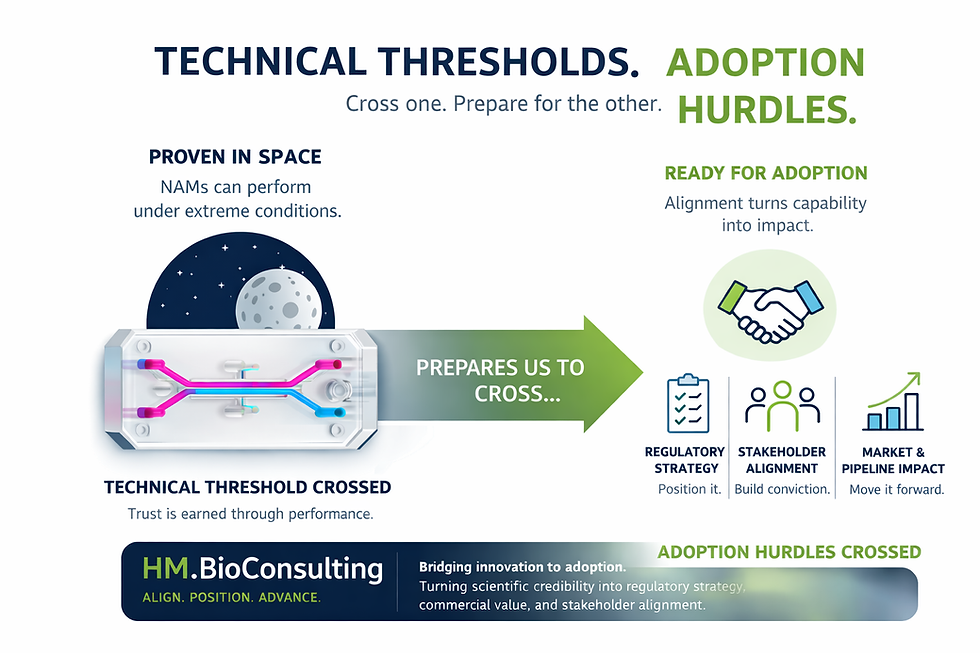
Science is advancing faster than the frameworks that are meant to absorb it. The tension lies in how to position, validate, and communicate these approaches within systems that were not originally designed for them. Therefore, a more integrated approach becomes essential. Scientific capability alone is not enough for accelerated adoption; this requires alignment across market access, regulatory strategy, workforce readiness, and internal communication. Moreover, it requires early engagement with regulators, a focus on human relevance, and organizational willingness to build literacy around increasingly data-driven development approaches.
Technical validation is only one threshold. Adoption requires trust, alignment, strategic positioning, and the operational ability to integrate new approaches into established decision-making frameworks.
At HM Consulting, this is exactly the intersection we focus on. Not science in isolation, but the pathway from innovation to adoption. How do you position NAMs not as replacements, but as enablers? How do you build internal conviction while navigating external skepticism? How do you move from pilot to pipeline?
The lesson from sending NAMs to the moon is not just that it can be done. It is that the threshold for trust has shifted. And once that threshold moves, the remaining distance between innovation and adoption becomes a question of execution rather than belief.


Comments